Build little worlds of AI people
Design agents with memories, habits and goals. Drop them in a pixel town, watch them plan their days, gossip and change their minds. Then step in and talk to any of them.
Open beta · bring your own OpenAI, Anthropic, Gemini or local model key
This scene runs on the same sprites the app uses. Nobody is steering.
- Memory stream + reflection
- Your keys, encrypted
- Snapshot & fork any moment
- Share a public watch link
- Telegram built in
How it works
From a blank map to a living town in minutes
Everything runs in the browser. You design, press Launch, and the agents take it from there.
Design your agents
Name, traits, lifestyle, daily plan and starting memories. Pick a sprite and a model for each one, or start from a ready-made cast.
Pick or draw a world
Use The Ville, start from a template, or paint your own with collision checks and a test walk.
Launch and watch
Agents perceive, plan, talk and reflect on their own. Speed it up, whisper a thought, change the weather, or replay it later.
Simulate
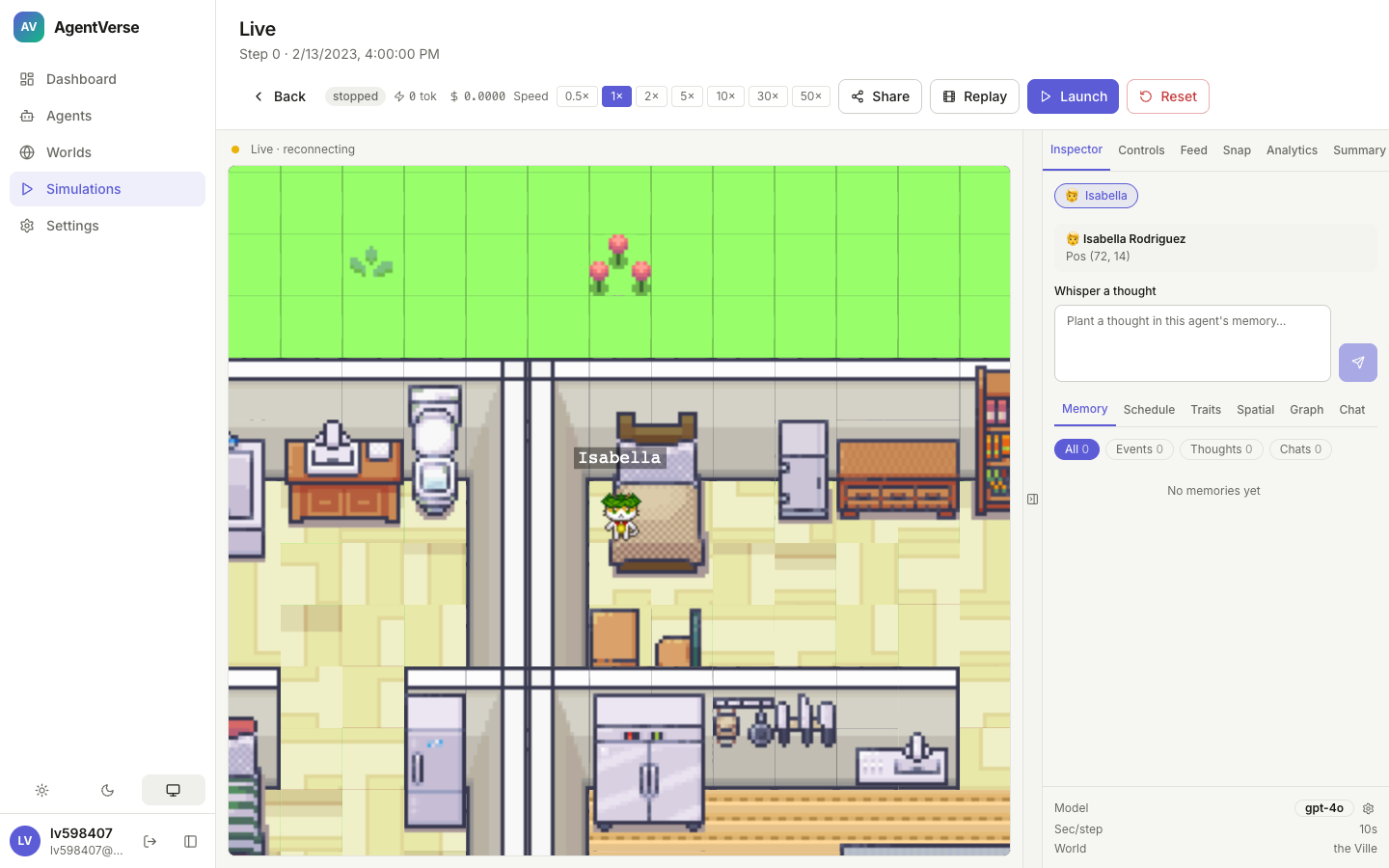
See what happens when nobody is in charge
Each agent runs its own loop of perceiving, remembering, planning and acting. You get the world, the controls and the receipts.
- Live view with speed from 0.5× to 50×, a feed of events and an inspector for every agent.
- Nudge the world: storms, announcements, whispered thoughts. They arrive as things agents perceive.
- Replay, summarise, export. A narrative summary, per-agent arcs, analytics, and CSV or JSON of every memory.
Chat
Then walk up and talk to one
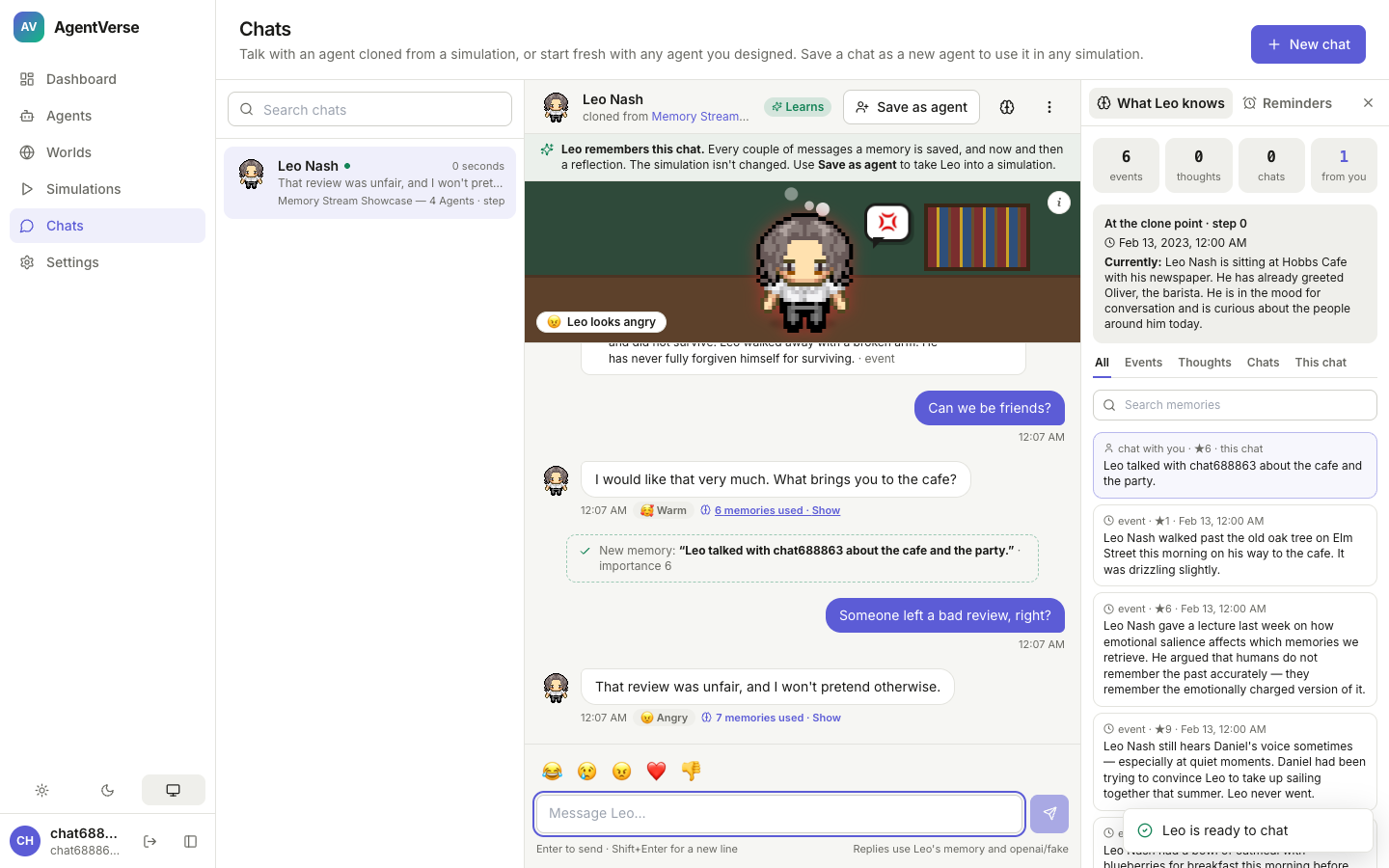
Clone an agent out of a simulation with everything it remembers, or start fresh from its design. It answers from its own life, and it shows you which memories it used.
- Learns or Frozen. Let the chat become memory, or keep the original untouched.
- Moods you can see. Each reply is tagged and acted out by the agent on a 4× stage.
- Reminders and check-ins that arrive on time, sent through your own Telegram bot.
- Save as agent. Turn a chat partner into a new library agent with chosen starting memories.
Memory you can inspect
Agents that remember what matters
Based on Stanford's Generative Agents research. Every memory is scored on how recent, how important and how relevant it is, so a vivid moment from last week can beat a boring one from this morning.
- Reflections form when enough important things pile up.
- Vector search on pgvector, built into the database.
- Open any reply to see the memories behind it, with scores.
Retrieval score · “Can we be friends?”
★6 “Leo gave a lecture on how emotional salience affects which memories we retrieve.” ranks first.
World editor
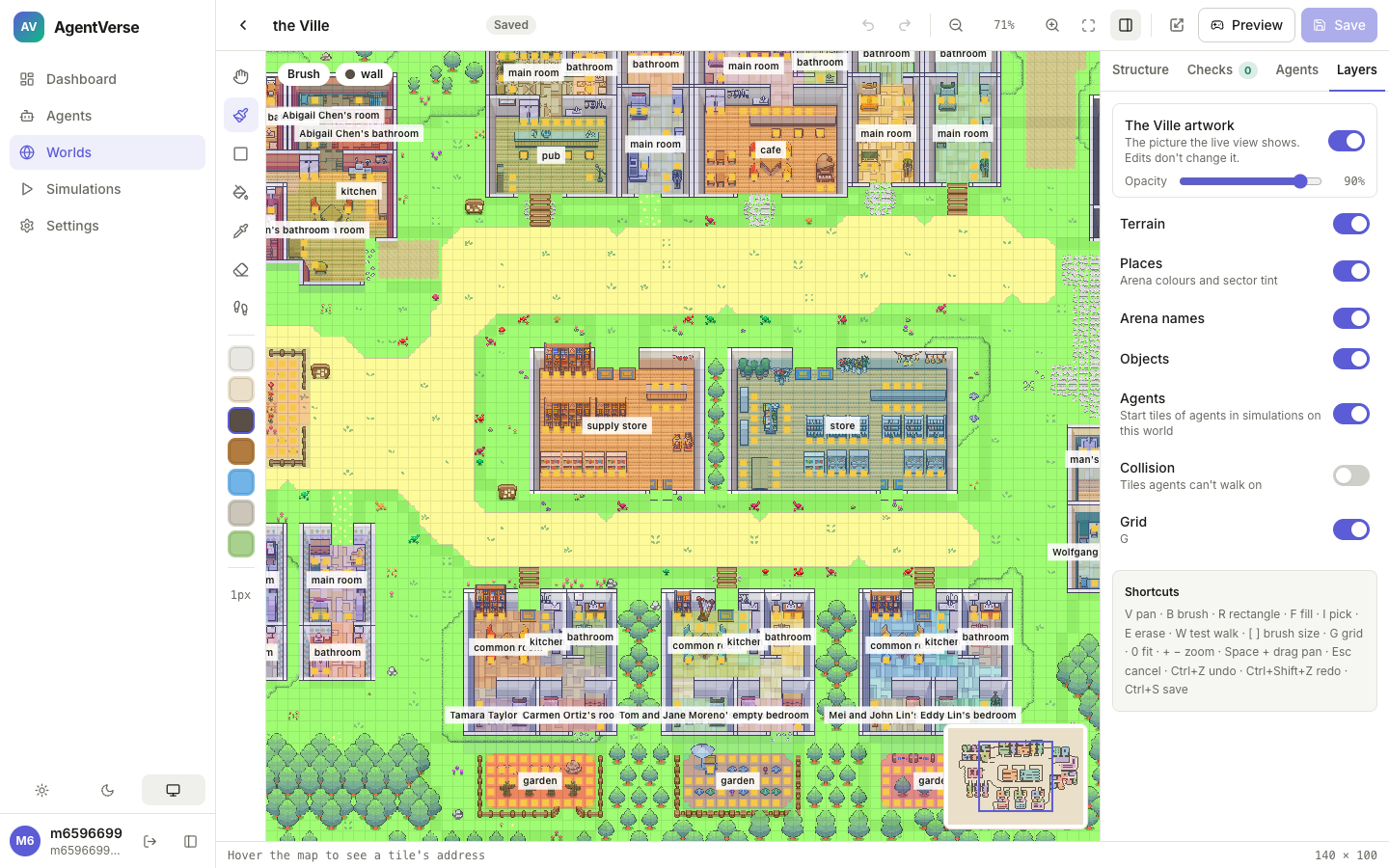
Draw the town your agents live in
A canvas editor with zoom, undo and a structure panel for arenas and rooms. Check that every agent can reach every place before you launch.
- Checks for unreachable spots, plus a test walk from any tile.
- Templates and resize.
- Edits to a world in use are saved as a copy, so running simulations stay safe.
And the rest
Built for experiments, not just demos
Any model, per agent
OpenAI, Anthropic, Gemini, Ollama or any OpenAI-compatible endpoint. Mix models inside one town and track token cost.
Snapshot and fork
Save any moment, then branch it. Change one thing and compare how the story diverges.
Public watch link
Share a read-only URL so anyone can follow a simulation live, no account needed.
Analytics and summaries
Who talked to whom, how moods moved, and a plain-language story of what happened.
Your keys stay yours
One key per provider, encrypted at rest. Nothing is shared between accounts.
Proactive agents
Reminders always fire. Check-ins are rare, polite and respect quiet hours in your timezone.
Use it for
Research, games, teaching, practice
Social research
Rerun the same town with one rumour changed and compare how it spreads.
Game and story design
Prototype NPC behaviour and watch emergent plot before you write a line of game code.
Teaching AI
Show students memory, retrieval and reflection with a system they can poke at.
Practice partners
Rehearse a hard conversation with a persona that remembers the last one.
- OpenAI
- Anthropic
- Google Gemini
- Ollama
- OpenAI-compatible
- Telegram
Pricing
Free while we're in beta
You pay your model provider directly. We don't mark up tokens.
Builder
$0during beta
Free while we learn what people need. Limits may change.
- Up to 5 agents
- 1 running simulation at a time
- 2 chats, with reminders and Telegram
- World editor, snapshots and public links
- Export everything you create
Team
Soon
For labs and studios.
- Shared workspaces
- Batch experiment runs
- Hosted models and spend caps
- Priority support
FAQ
Good questions
Do I need my own API key?
Yes. Add a key for each provider you use in Settings. They are stored encrypted, and your simulations and chats use them directly.
Can I use a local model?
Yes, through any OpenAI-compatible endpoint, as long as it is reachable from our servers. Embeddings for memory run on our side with a local model, so they don't use your key.
What does a simulation cost to run?
Agents make several model calls per step, so cost grows with agents and speed. The app shows live token usage and cost, and you can choose a cheaper model per agent.
Are the agents real people?
No. They are AI characters. They don't invent real meetings or contacts, and anything they send you, such as a Telegram reminder, comes from an agent you created.
Who can see my agents and chats?
Only you, unless you create a public watch link for a simulation. Chats and memories are private to your account, and you can delete memories or whole chats at any time.
Where does this come from?
AgentVerse builds on the open-source Generative Agents project from Stanford and Google (Park et al., UIST 2023), rebuilt as a cloud app with a modern interface.
Your first town is a few clicks away
Pick a cast, press Launch, and see who walks into the cafe.